Minoxidil is the only topical hair-loss drug approved for both men and women, has been on sale since 1988, and produces visible regrowth in about 4 in 10 people who use it properly for a year. It does not touch the hormonal cause of pattern baldness, so what it grows stays only while you keep applying it. The seven minoxidil products available to order are listed first; the rest of the page covers what decides which one to take.
Minoxidil-based products
Prices are current list prices in USD and change with pack size. Each card opens the product page in a new tab.
What minoxidil is
Minoxidil started life in the 1970s as Loniten, an oral tablet for severe high blood pressure. Patients on it grew hair in places they did not want it, and Upjohn spent the next decade turning the side effect into a product. Rogaine 2% solution was approved in the US in 1988 on prescription, went over the counter in 1996, and the 5% strength for men followed in 1997. The 5% foam arrived in 2006. The patents expired long ago, which is why a 60 ml bottle of generic 5% now costs a fraction of the brand.
Chemically it is a piperidino-pyrimidine oxide, a potassium-channel opener. On the scalp it is a prodrug: an enzyme in the outer root sheath of the follicle, sulfotransferase SULT1A1, has to convert it into minoxidil sulfate before it does anything. People with low SULT1A1 activity get little or no effect no matter how carefully they apply it. That single enzyme explains most of the gap between responders and non-responders.
What it does to a follicle
Androgenetic alopecia shrinks follicles over successive growth cycles until they produce only fine vellus fuzz. Minoxidil counters that in three ways:
- It lengthens anagen, the growth phase, so a hair stays on the head longer before it sheds.
- It shortens telogen, the resting phase, and kicks resting follicles back into growth early. This is the cause of the shedding wave in the first two months: old resting hairs get pushed out to make room.
- It enlarges miniaturised follicles, so the hair they produce is thicker and darker. The mechanism is partly vascular (more blood flow via VEGF) and partly direct stimulation of dermal papilla cells through prostaglandin E2.
What it does not do: block dihydrotestosterone. The hormone that caused the miniaturisation is still there, which is why minoxidil slows the loss but rarely stops it on its own, and why dermatologists usually pair it with finasteride in men.
Strengths and forms
| Form | Who it is for | Dose | Notes |
|---|---|---|---|
| 2% solution | Women; men who cannot tolerate 5% | 1 ml twice daily | The original. Weaker, fewer side effects. |
| 5% solution | Men; women under medical advice | 1 ml twice daily | Standard of care. Contains propylene glycol, which irritates some scalps. |
| 5% foam | Men twice daily; women once daily | Half a capful | No propylene glycol, dries faster, less itching. Same efficacy as solution. |
| 10% solution | Non-responders to 5% who want to try more | 1 ml twice daily | No published trial shows it beats 5%. More irritation, more unwanted facial hair. |
| Oral tablets 2.5–10 mg | People who fail or hate topicals | 0.25–5 mg once daily (split tablets) | Off-label. Stronger regrowth, systemic side effects. Needs blood-pressure check. |
| 5% + finasteride topical | Men wanting both drugs in one bottle | 1 ml twice daily | Morr F combines minoxidil 5% with finasteride 0.1%. Lower systemic finasteride exposure than tablets. |
What the trials actually show
The reference study is Olsen’s 48-week trial of 393 men, published in 2002. Non-vellus hair counts in a one-inch target circle rose by 18.6 hairs/cm² on 5% solution, 12.7 on 2%, and 3.9 on placebo. The 5% group had 45% more regrowth than the 2% group and saw it sooner. Patient-rated improvement at 48 weeks was reported by about 60% of the 5% group.
Foam was tested against solution in a 2011 head-to-head: 5% foam twice daily matched 5% solution for hair count with less scalp irritation. A separate trial put women on 5% foam once daily and found it equal to 2% solution twice daily, which is why the once-daily foam is now the usual recommendation for women.
For oral minoxidil the key data come from a 2021 multicentre review of 1,404 patients on low doses (median 2.5 mg for men, 1 mg for women). Hypertrichosis, unwanted body hair, occurred in 15.1%; lightheadedness in 1.7%; fluid retention in 1.3%; fast heartbeat in 0.9%. Only 1.7% stopped because of side effects. Regrowth was generally judged stronger than with topical, though direct comparisons are small.
Across these trials, about 40% of users see clear regrowth, another 30% or so hold their density, and the rest get little. Responders are the people with enough SULT1A1 in their follicles, and there is no cheap test for it. A six-month trial is the test.
Pros and cons
Pros
- Approved for men and women; the only topical with that status.
- 35 years of safety data, including over-the-counter use since 1996.
- No hormonal effect, so none of the sexual side effects linked to finasteride.
- Works on the crown and, with less certainty, on the hairline.
- Cheap as a generic: a month of 5% solution costs less than a haircut.
- Stacks with finasteride, microneedling and ketoconazole shampoo.
- Oral form rescues many topical non-responders.
Cons
- Fewer than half of users are strong responders, and there is no way to tell in advance.
- Twice-daily application for life. Stop, and gains are gone within 3 to 4 months.
- A shedding wave at weeks 2 to 8 scares many people off before it works.
- Solutions leave the hair greasy and can irritate the scalp (propylene glycol).
- Unwanted hair on the forehead, cheeks and temples if it runs or is over-applied.
- Oral tablets can cause ankle swelling, dizziness and a faster pulse; not for people with heart disease.
- Does nothing for the hormone driving the loss, so it is a brake, not a cure.
What to expect, month by month
| Timeframe | What happens |
|---|---|
| Weeks 1–2 | Nothing visible. Some scalp tingling or dryness, mainly with solution. |
| Weeks 2–8 | Shedding increases. Resting hairs are being pushed out. This is the drug working, not failing. Most people who quit, quit here. |
| Months 2–4 | Shedding stops. Fine, pale new hairs appear at the crown. |
| Months 4–6 | New hairs thicken and pick up pigment. First point where photos show a difference. |
| Months 6–12 | Peak response. If nothing has changed by month 6, you are probably a non-responder; consider oral minoxidil or adding finasteride. |
| Year 2 and on | Maintenance. Density holds or slips slowly as the underlying hormonal loss continues. |
| After stopping | New hair sheds over 3–4 months. Scalp returns to where it would have been without treatment. |
Side effects, by form
Topical. Itching, flaking and redness in roughly 6% of users on solution, under 2% on foam; most of it is the propylene glycol, not the drug. Unwanted facial hair in 3 to 5% of women, usually from the product running down the temples. Headache and dizziness are rare but happen when too much is applied to a broken or inflamed scalp. Allergic contact dermatitis to minoxidil itself exists but is uncommon; switching to foam does not fix it, switching to oral does.
Oral. At hair-loss doses (0.25 to 5 mg) the common issue is hypertrichosis, roughly 1 in 7 users, more at higher doses and in women. Fluid retention, lightheadedness on standing and a faster resting pulse each affect 1 to 2%. Pericardial effusion is a documented risk at blood-pressure doses (10 to 40 mg) and has been reported sporadically at 5 mg; it is the reason oral minoxidil is a prescription product and why anyone with cardiac history, low blood pressure or kidney disease should not self-medicate with it.
Who should skip it
- Pregnant or breastfeeding women, both forms.
- Anyone under 18: no trial data.
- People with sudden, patchy or total hair loss. Minoxidil treats pattern thinning, not alopecia areata, scarring alopecia or loss from illness or medication.
- Scalp with open wounds, sunburn or active psoriasis: absorption rises sharply.
- For oral tablets: heart failure, angina, recent heart attack, pericardial disease, pheochromocytoma, or anyone already on a vasodilator.
- Cat owners should keep bottles locked away. Minoxidil is lethal to cats at tiny doses, and licking a treated pillow has killed pets.
How to apply it so it works
- Apply to a dry scalp, twice a day, 8 to 12 hours apart. Wet hair dilutes the dose and spreads it to the face.
- Solution: 1 ml, measured with the dropper, dotted across the thinning area then spread with a fingertip. Foam: half a capful, dispensed onto cool, dry fingers and massaged in.
- Part the hair and put it on skin, not on hair. Minoxidil on hair does nothing.
- Wash hands immediately. Leave the scalp alone for 4 hours before washing, swimming, or a hat.
- Night dose: let it dry fully (about 20 minutes for foam, 45 for solution) before your head touches the pillow.
- Take a photo under the same light on day 1 and every 30 days. Memory is useless for judging slow change.
- Do not double up after a missed dose. Just take the next one.
- If the scalp itches badly on solution, switch to foam before giving up. If you itch on foam too, try oral.
Oral minoxidil: the practical details
The tablets sold for hair loss, Lonitab 5 mg and 10 mg among them, are the same product cardiologists prescribe for resistant hypertension. The hair-loss doses are far lower: men typically start at 1.25 to 2.5 mg once daily, women at 0.5 to 1 mg, which means quartering or halving a 5 mg tablet with a pill cutter. Dermatologists titrate upward only if there is no response after 3 to 6 months and blood pressure is stable.
Two things to arrange before the first tablet: a baseline blood-pressure reading, and a plan to check it again at two weeks and two months. Ankle swelling that does not settle, breathlessness lying flat, or a resting pulse over 100 means stop and see a doctor. Hypertrichosis is manageable: lower the dose, or accept it and shave.
The products, one by one
Every item below is in stock and ships worldwide. Prices are per unit at the time of writing; multi-packs are cheaper.
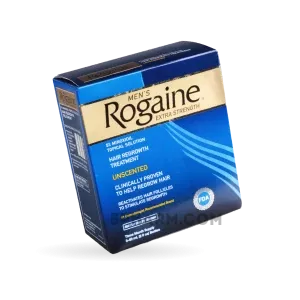
Rogaine
Minoxidil 2% / 5% · 60 ml · Kenvue (formerly Johnson & Johnson), USA
The brand that every generic is copied from. Same 5% minoxidil in a propylene-glycol and alcohol base, same dropper, same 1 ml twice-daily dose. You are paying for the name and for a quality-control record going back to 1988, nothing else.
Makes sense for a first trial if you want the reference product, or if a familiar box matters at customs. Once you know you respond, a generic does the same job.
$51.30per bottle
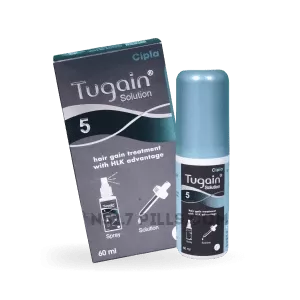
Tugain Solution
Minoxidil 2% / 5% · 60 ml · Cipla, India
Cipla is one of the largest generic makers in the world and Tugain is its minoxidil line, dispensed in Indian pharmacies by the million. 5% is the strength to start with; 2% exists for women and for scalps that cannot take the full dose.
The usual starting point: same molecule and same vehicle as Rogaine at roughly a fifth of the price per millilitre in multi-packs.
$46.60per bottle
Minoxytop
Minoxidil 5% / 10% · 60 ml · Healing Pharma, India
The only product in this list offered at 10%. Minoxytop 5% is an ordinary solution; the 10% doubles the concentration in the same alcohol and propylene-glycol base. No trial shows 10% beating 5% on hair count, and irritation and facial-hair complaints rise with strength.
The 10% belongs at the end of the topical road, after six months on 5% with nothing to show, and before oral. It is not a starting product.
$42.30per bottle
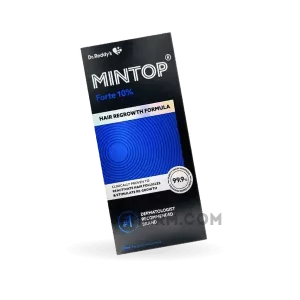
Mintop Solution
Minoxidil 2% / 5% · 60 ml · Dr. Reddy’s Laboratories, India
Dr. Reddy’s version, interchangeable with Tugain. Bottle comes with a dropper and a spray head; the spray is handy for a wide thinning crown but wastes product on the hair rather than the scalp, so the dropper gives a more accurate 1 ml dose.
Cheapest 5% solution on the page. Mintop and Tugain are clinically identical, so buy whichever is less that month.
$35.50per bottle
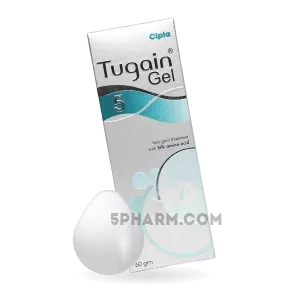
Tugain Gel
Minoxidil 5% · 60 g · Cipla, India
A 5% minoxidil in a clear gel rather than a liquid. It does not run, so it stays where you put it: useful for hairline application, for people who sweat heavily, and for anyone whose solution keeps ending up on their forehead. Dries slower than foam, so give it 30 minutes before a pillow or a hat.
A niche form at a premium price: right for the hairline or for people whose solution drips, and otherwise outdone by the plain Tugain solution at a lower price.
$127.25per tube
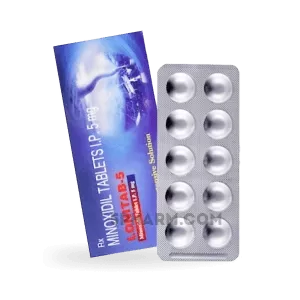
Lonitab
Minoxidil tablets 5 / 10 mg · Intas Pharmaceuticals, India
Oral minoxidil, the same tablet used for severe hypertension. For hair loss the dose is 0.5 to 2.5 mg once daily, so a 5 mg tablet is cut into halves or quarters; a 10-tablet strip lasts a month or more. Regrowth is stronger and more consistent than with topicals because the drug reaches every follicle through the bloodstream, including the ones you cannot reach with a dropper.
Order the 5 mg rather than the 10 mg, and a pill cutter with it. Take a blood-pressure reading before the first dose and again two weeks in; the oral-minoxidil section above covers the rest.
$6.07per pill
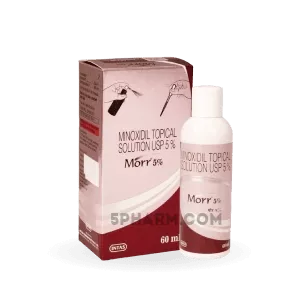
Morr F
Minoxidil 5% + Finasteride 0.1% · 60 ml · Intas Pharmaceuticals, India
Two drugs in one bottle: 5% minoxidil to push growth and topical finasteride to cut scalp DHT, the hormone shrinking the follicles. Topical finasteride lowers scalp DHT by a similar amount to the tablet while putting far less of the drug into the bloodstream, so sexual side effects are less likely. Applied like any 5% solution, 1 ml twice daily.
Made for men who want the finasteride effect without tablets, or who tried the tablets and stopped. Not for women.
$86.00per bottle
Before you order
- Decide on form first: foam if your scalp is sensitive, solution if you want cheap, oral if topicals failed or you will not keep up twice-daily application.
- Buy three months at once. A single bottle gets you through the shedding phase and no further, which is where most people quit.
- Check the expiry: minoxidil solution degrades after opening, so a 3-pack beats one large bottle.
- Customs: minoxidil topicals are over-the-counter in the US, UK and EU and clear without issue. Oral minoxidil is prescription-only in most countries; personal-import rules vary.
- Pair it with finasteride if you are male and the hairline is going: the combination beat either drug alone in the trials that compared them. The finasteride products are on the where-to-buy page.
Questions people ask before buying
Does 10% work better than 5%? There is no trial showing it does. One small study found 10% no better than 5% at 24 weeks with more side effects. It is a reasonable last try before oral, not a first choice.
Can I use it once a day instead of twice? Once daily gives roughly 60 to 70% of the twice-daily effect for solution. The foam at 5% once daily is adequate for women by trial data; for men, twice is the tested dose.
Will it work on a receding hairline? Less reliably than on the crown. The frontal trials are small and mixed. Finasteride is the better drug for the hairline; minoxidil helps at the margins.
Does it work for a beard? There is one 16-week trial in 48 men showing 3% minoxidil increased beard hair count versus placebo. It is off-label and the effect is modest.
Can I stop once it has grown back? No. Whatever it grew, it will shed within 3 to 4 months of stopping. It is a maintenance drug.
Is oral stronger than topical? Usually, and it is far easier to keep up with. The cost is systemic side effects and the need to watch blood pressure.
Full hair-loss catalog
Finasteride, dutasteride and the combination products are on the hair-loss category page.
Sources
- Olsen EA et al. A randomized clinical trial of 5% topical minoxidil versus 2% topical minoxidil and placebo in the treatment of androgenetic alopecia in men. J Am Acad Dermatol 2002;47:377–85.
- Blume-Peytavi U et al. A randomized, single-blind trial of 5% minoxidil foam once daily versus 2% minoxidil solution twice daily in the treatment of androgenetic alopecia in women. J Am Acad Dermatol 2011;65:1126–34.
- Vañó-Galván S et al. Safety of low-dose oral minoxidil for hair loss: a multicenter study of 1404 patients. J Am Acad Dermatol 2021;84:1644–51.
- Goren A et al. Clinical utility and validity of minoxidil response testing in androgenetic alopecia. Dermatol Ther 2015;28:13–16.
- Randolph M, Tosti A. Oral minoxidil treatment for hair loss: a review of efficacy and safety. J Am Acad Dermatol 2021;84:737–46.
- Suchonwanit P et al. Minoxidil and its use in hair disorders: a review. Drug Des Devel Ther 2019;13:2777–86.
- US FDA. Rogaine (minoxidil topical solution) approval history, NDA 019501.